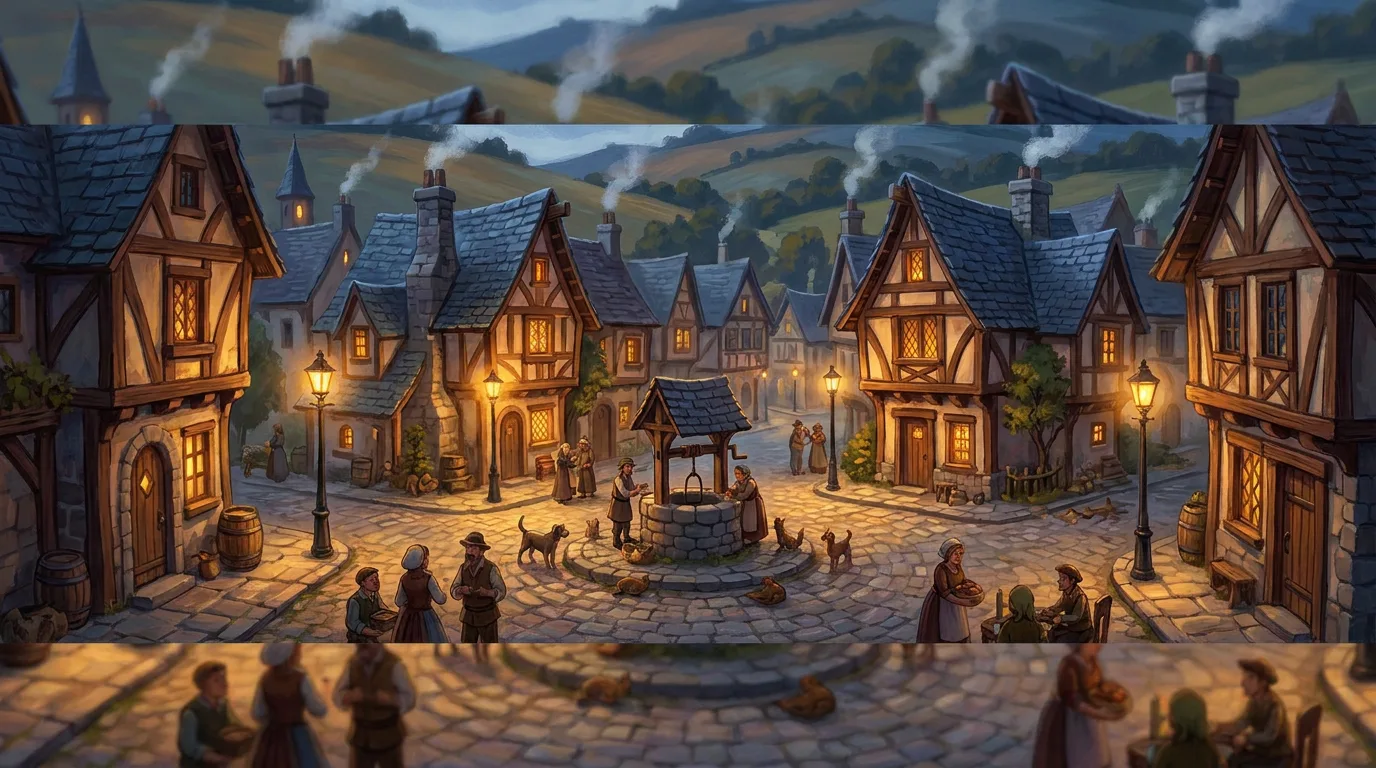
How real towns got their names (and how to invent yours)
Real town names are rarely invented; they are accreted. Somebody described a place, the description stuck, and a thousand years of lazy pronunciation wore it smooth. This generator builds names the same way real ones formed, by fusing landscape, founders, trades, and settlement words, and this page explains where authentic town names come from and how to choose invented ones that hold up.
Where real town names come from
Most town names encode one of four things. The first is geography. English villages are full of fords, bournes, combes, and leys because the name answered a practical question: what is here? Oxford was the ford where oxen crossed; a -combe village sits in a valley; a -field village sat on open, cleared land. The second is a founder or owner. Thousands of settlements are simply a personal name welded to a settlement word, a pattern America repeated at industrial scale: pick a landowner, a railroad executive, or a war hero, add -ville, -burg, or plain Junction, and incorporate. The third is trade. Market towns, mill towns, salt towns, and port towns advertised their function in their names, which is why the map still carries so many Millfields, Saltfords, and Market Something-or-others. The fourth is the imported name: settlers arriving somewhere new and naming it for somewhere old, which is how the United States acquired dozens of Parises, Athenses, and New Londons. A name that does none of these four jobs tends to feel made up, because it is.
Consistency is what makes invented maps believable
For fiction, tabletop campaigns, and game worlds, the single most useful rule is that neighboring towns were usually named by the same people, so they should share a naming culture. Pick one style per region and keep to a small set of endings: a shire-like homeland of -tons, -burys, and -fords; a frontier province of gulches, wells, and forts; a haunted march of hollows and moors. When a name breaks the local pattern, let the break mean something. A gothic Ravenmoor in the middle of cheerful -ville country is a plot hook the reader feels before you explain it. It also helps to name the region before its towns, then let the biggest settlement either inherit the regional sound or defy it for a reason you can state in one sentence.
Practical tips for picking from a batch
Generate more names than you need and audition them out loud, because characters and players will have to say them. Two or three syllables with a clear stress, like Marlow Cross or Dustspur, survive repeated dialogue better than long compounds. On a map, avoid two labels that start with the same three letters in the same region; readers navigate by first syllables. Keep the rejects on a bench list, since discovery-driven campaigns burn through settlements quickly and improvised sessions stay coherent when the spare names already match the region's style.
How the generator works
Under the hood, each of the six styles owns a curated corpus of prefixes, founder surnames, landscape and trade stems, genuine toponymic suffixes, geographic terms, and standalone names, more than two hundred and fifty components in total, plus combination schemes modeled on real naming patterns: fused compounds like Ashbury, possessives like Tanner's Gulch, and chart-plain entries like Harper Creek. A seeded random engine walks those schemes, so results are deterministic for a given seed. The worked examples further down this page are generated by the exact same code and verified by automated tests, so what you see is what the tool truly produces. Generate a batch, keep the two or three names that suggest a story on their own, and run it again.